
 Micro Dynamic Sensor
  Test Accessories
  Digital Image Measurement
  Geotechnical Tests
  Hydrate
  In-situ Tests
  Engineering Investigation
  Drilling Rigs
  Ocean Testing
 Project Category: Seismic Reduction Test of Pile Foundation
1. Project Overview
Due to the special geographical location of the gulf areas in Hainan Province, seawater continuously infiltrates the soil mass. After a series of long-term transformations, humus and other substances in the seawater penetrate into the interior or adhere to the surface of the sand, forming a special type of gulf facies organic matter-impregnated sand [1]. In recent years, with the rapid development of various large-scale offshore projects in Hainan, such as high-pile wharves and offshore oil and gas platforms, all have been constructed in coastal gulf areas.
Moreover, Hainan Island and its adjacent offshore areas belong to the Leiqiong Seismic Subzone of the Southeast Coastal Seismic Belt in mainland China, where four seismic swarm regions are distributed, namely the Beibu Gulf Seismic Swarm, the Northeastern Hainan Seismic Swarm, the Southwestern Hainan Seismic Swarm and the Southeastern Hainan Seismic Swarm [1]. With the wide application of pile foundations, many practical engineering problems have emerged, among which the seismic performance of pile foundations has become a key concern.
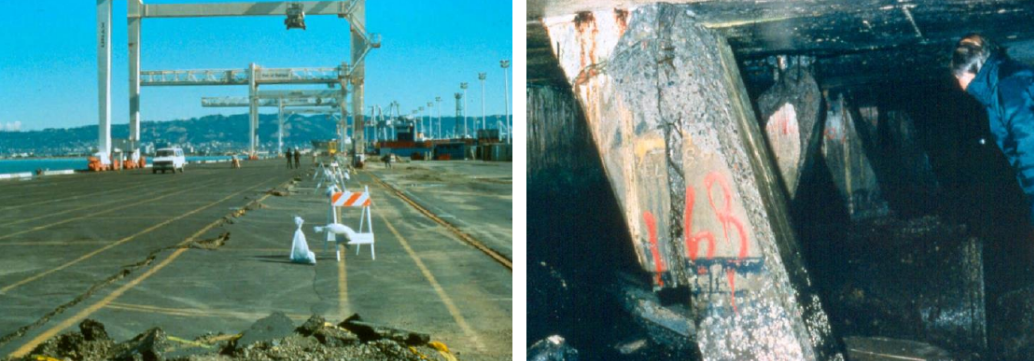
Figure 1 Failure of Wharf Pile Foundation
2. Service Content
For this project, services such as calibration of pore pressure sensors and earth pressure sensors, as well as remote data analysis and processing, shall be provided to the project owner.
The pore pressure sensors provided for this project shall record in real time the "instantaneous" excess pore water pressure data and liquefaction dynamic response of pile-saturated foundations under seismic loads; the earth pressure sensors provided shall record in real time the dynamic earth pressure data of pile-soil interaction under seismic loads.
The pore pressure sensors used in this project shall meet the following requirements: miniaturization (diameter ≤ 10mm), high frequency response rate (response time ≤ 0.1ms), permeable stones that can be cleaned and saturated independently, resistance to swept-frequency vibration (frequency ≥ 10~300Hz), and resolution ≤ 0.020kPa (for recording changes in pore water pressure within the soil). The earth pressure sensors shall meet the requirements of: miniaturization (diameter ≤ 12mm), high frequency response rate (response time ≤ 0.1ms), resistance to swept-frequency vibration (frequency ≥ 10~300Hz), and resolution ≤ 0.10kPa (for recording changes in earth pressure from pile-soil interaction). More importantly, both the pore pressure sensors and earth pressure sensors shall be resistant to seawater corrosion and capable of withstanding high-temperature and humid environments for a long time.
This project requires a failure rate of ≤ 5% for pore pressure sensors, ≤ 5% for earth pressure sensors, and a working condition duration of ≥ 7 days.
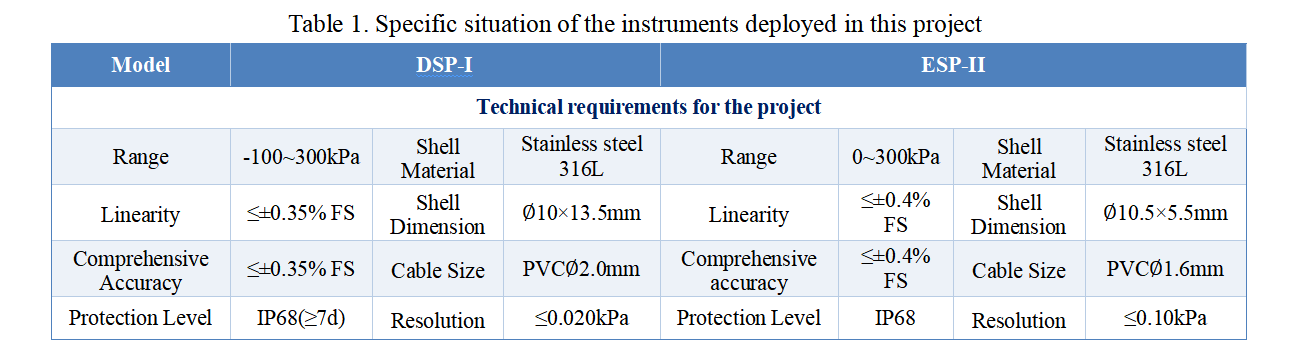
The instrument models provided for this project are DSP-I pore pressure sensor and ESP-II dynamic earth pressure sensor, with the main parameters shown in Table 1.
3. Project Overview and Representative Data
(1) Experimental equipment
This shaking table test adopts a 3m×3m horizontal bidirectional seismic simulation test system, which has a load-bearing capacity of 10 tons, an anti-overturning moment of 30 ton-m, a full-load acceleration of ±1.1g in the X and Y directions, and a frequency range of 0Hz to 50Hz. It can accept input of any waveforms such as sine waves and seismic ground motion waveforms.
(2) Experimental materials and saturation method
The test chamber used in this test is a rigid model box with observation windows; the sand used for the test is bay facies organic matter-impregnated sand [2]. The sand rain method is adopted to prepare the model in layers, with the corresponding soil layer thickness being 9.5m (converted to the prototype); seawater is selected as the saturation fluid for the saturated soil model, and the normal gravity natural saturation method is used, with the saturation time set to 168h.
(3) Experimental model and sensor deployment plan
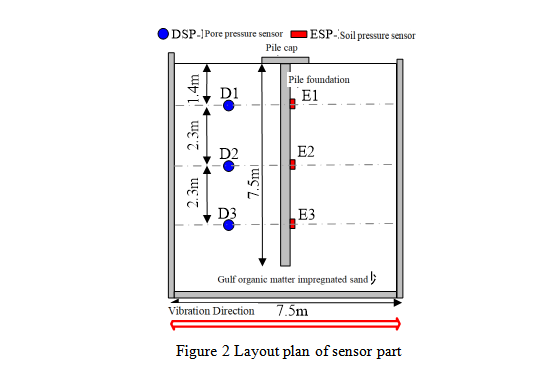
The sensor deployment plan is shown in Figure 2.
(4) Partial power test results
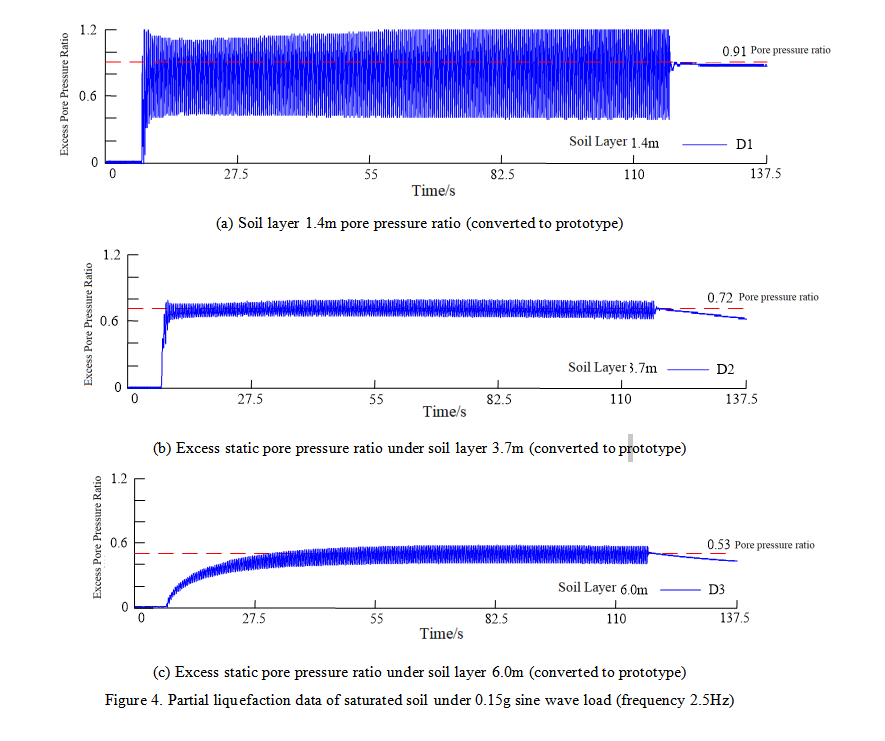
4. Service evaluation
The seismic project of a pile foundation in a certain offshore bay lasted for 7 days. Our technical personnel provided remote technical services such as sensor layout guidance, fault diagnosis, sensor calibration and maintenance, debugging of data acquisition instruments, data processing and analysis. More importantly, the data recorded by DSP-I pore pressure sensors and ESP-II earth pressure sensors provided important information for seismic research of offshore pile foundation engineering.
User evaluation: The DSP-II pore pressure sensor and ESP-II dynamic earth pressure sensor have good frequency response rate and stability, long service life, and can be well applied to complex engineering environments (strong vibration/impact, high temperature and humidity, seawater corrosion). Especially, the DSP-II pore pressure sensor can accurately record the "instantaneous" increase and change of ultra static pore water pressure in pile foundation during liquefaction process.
References:
[1] Zhang Hui, Li Zhixiong, Li Sheng Preliminary Study on the Speed Ratio Characteristics of Hainan Island and Near Sea Waves [J]. Journal of Earthquake Engineering, 2018, 40 (3): 524-534
[2] Du Juan, Liu Bingyang, Zheng Gang, Wei Jing, Hu Jun, Wei Hong Experimental study on dynamic characteristics of organic matter impregnated sand in bay phase Journal of Geotechnical Engineering, 2019,41 (S2): 65-68
[3] Stewart J P, Bray J D, Seed R B, et al. Preliminary report on the principal geotechnical aspects of the January 17, 1994 Northridge earthquake[J]. University of California, Berkeley, Earthquake Engineering Research Center. Report UCB/EERC-94/08. Berkeley: Earthquake Engineering Research Center, University of California, 1994.

 Customer Service QQ