
 Micro Dynamic Sensor
  Test Accessories
  Digital Image Measurement
  Geotechnical Tests
  Hydrate
  In-situ Tests
  Engineering Investigation
  Drilling Rigs
  Ocean Testing
 Project category: Anti wave flow test of pile foundation
1. Project Overview
Pile foundations are an important type of foundation for marine structures. They are widely used in nearshore shallow-water conditions and have strong adaptability to geological conditions and load environments, making them extensively applied in projects such as offshore wind turbines, offshore platforms, and cross-sea bridges. In the rapidly developing offshore wind power projects in recent years, monopile foundations with a diameter of 5-7 meters have been widely used, accounting for more than 70% of the foundations of completed offshore wind turbines worldwide. In practical projects in China, such as the Rudong Wind Farm, monopile foundations have also gradually been put into use and hold broad application prospects in regions like the Bohai Sea and the East China Sea. However, due to the relatively shallow water depth where they serve, incidents such as wind turbine shutdowns and instability damage to oil and gas platforms under the action of marine environmental loads like typhoons and huge waves are not uncommon.
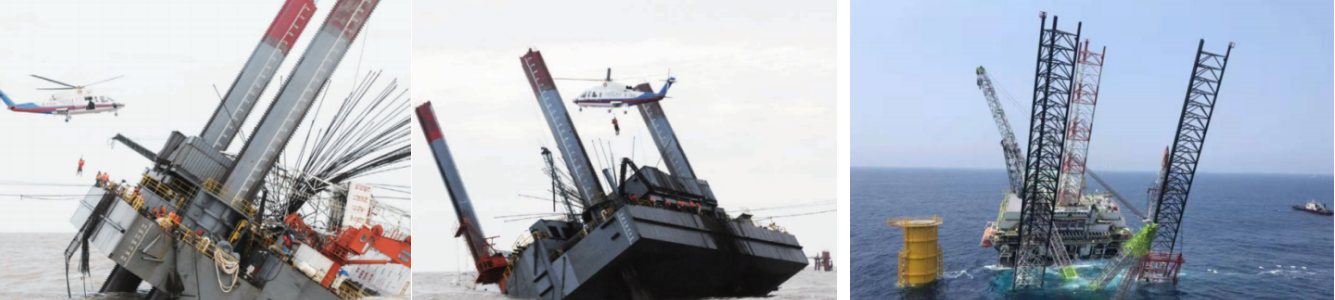
Figure 1: Sinopec Victory Operation Platform "9-7" Tilt Accident and CGN New Energy Offshore Wind Power Construction Platform Tilt Accident
2. Service Content
For this project, technical services such as instrument calibration and on-site sensor installation guidance shall be provided to the project owner.
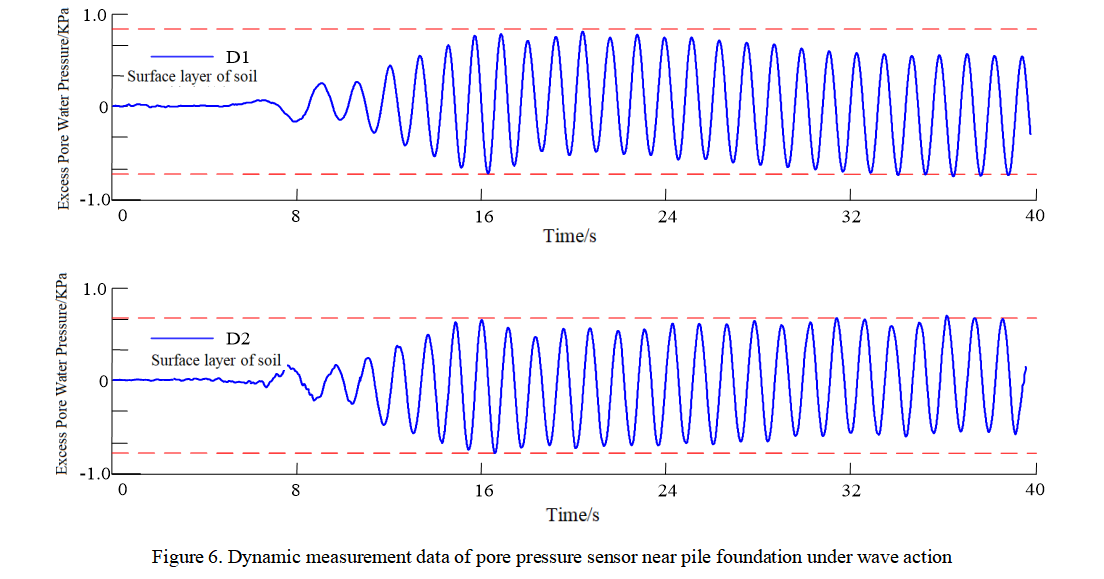
The pore pressure sensors provided for this project shall be capable of recording the "instantaneous" excess pore pressure when the seabed soil around the pile foundation undergoes liquefaction.
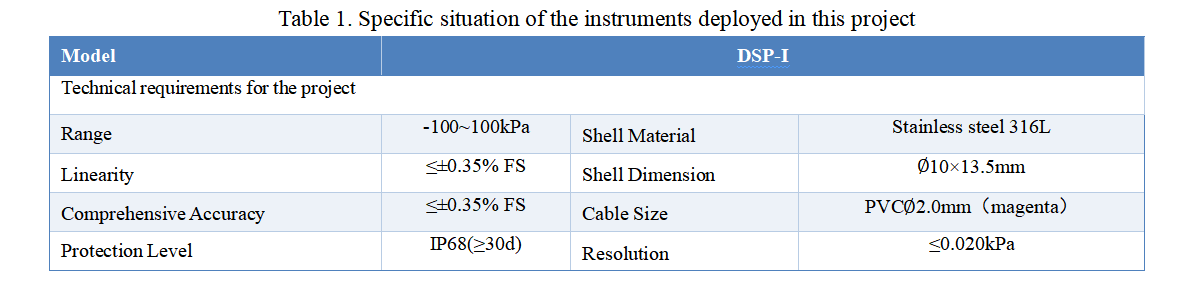
The pore pressure sensors used in this project shall meet the following requirements: miniaturization (diameter ≤ 10mm), small sensor wire diameter (to reduce interference with the flow field), high frequency response rate (response time ≤ 0.1ms), permeable stone can be cleaned and saturated separately, the color of the sensor cable needs to be clearly distinguished from white sand, and the resolution should be ≤ 0.020kPa (to record changes in pore water pressure in the soil); More importantly, it is required that the pore pressure sensor can work for a long time in a fluid environment.
This project requires the failure rate of the pore pressure sensors to be ≤ 5% and the working condition duration to be ≥ 30 days.
The instrument model provided for this project is DSP-I pore pressure sensor, and its key technical parameters are shown in Table 1.
3. Project Overview and Representative Data
(1) Experimental equipment
This test adopts a fluid-solid-soil coupled wave-current flume and a synchronous testing system, which is an experimental device specifically designed to simulate the dynamic coupling effect of "wave/current – underwater structure – seabed soil". The device has a total length of 52 meters, a width of 1.0 meter, and a depth of 1.5 meters (with a total depth of 3.3 meters in the test section), and can simultaneously generate regular waves/random waves and bidirectional variable-speed currents.
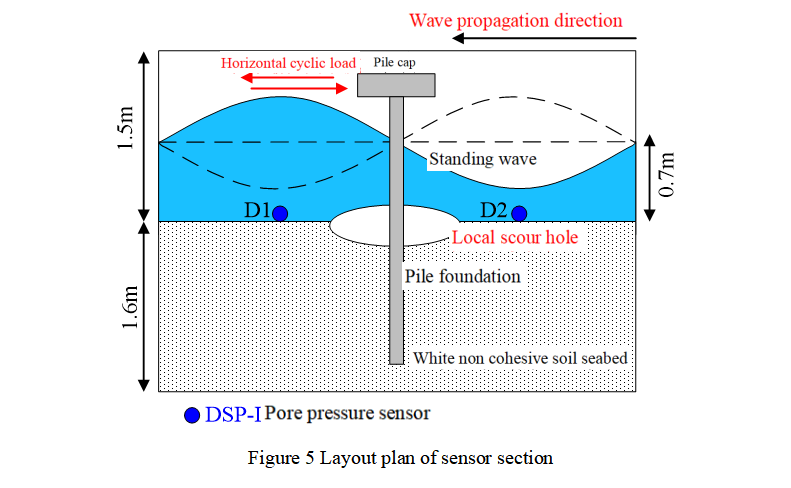
(2) Sensor deployment plan
The sensor deployment plan is shown in Figure 5.
(3) Representative data of power test
4. Service evaluation
For this scouring test on the monopile foundation of an offshore wind turbine under wave-current action, our technical personnel provided on-site full-process technical services, including guidance on sensor layout schemes, fault diagnosis, sensor calibration, debugging of data acquisition instruments, and data processing. More importantly, the data recorded by the DSP-I pore pressure sensors has provided crucial information for studying the liquefaction resistance of pile foundations under the action of standing waves.
User Evaluation: The DSP-I pore pressure sensors exhibit excellent frequency response rate, stability, high resolution, and a long service life. They can be well adapted to complex marine engineering environments and can accurately record the variation law of excess pore water pressure of pile foundations under wave action.
References:
[1] Qi Wengang, Hu Cun, Gao Fuping Wave current pile seabed dynamic coupling effect and its influence on the horizontal bearing characteristics of single piles [A]. Chinese Society of Mechanics, Beijing Institute of Technology Proceedings of the Chinese Mechanics Congress 2017 and the 60th Anniversary Celebration of the Establishment of the Chinese Society of Mechanics (A) [C]. Chinese Society of Mechanics, Beijing Institute of Technology: Chinese Society of Mechanics, 2017:9
[2] Du Fengchao Geological Analysis of the Overturning of the No.3 Workover Platform in Shengli Oilfield [D]. Ocean University of China, 2013
[3] On July 25, 2021, a construction platform tilted in the Huizhou sea area of Guangdong Province https://www.chinanews.com/sh/2021/07-25/9528223.shtml [China News Network]

 Customer Service QQ