
 Micro Dynamic Sensor
  Test Accessories
  Digital Image Measurement
  Geotechnical Tests
  Hydrate
  In-situ Tests
  Engineering Investigation
  Drilling Rigs
  Ocean Testing
 Project Category: Seismic Reduction Test of Pile Foundation
1. Project Overview
In recent years, the construction of various large-scale projects in China has experienced rapid development. Such projects as high-pile wharves, high-speed railways, cross-sea bridges, port engineering, and offshore development platforms have all entered a phase of accelerated advancement.
As the core component of any engineering project, the importance of foundation engineering is self-evident. Pile foundations have become the most prevalent form of deep foundations in the field of civil engineering at present [1]. With the widespread application of pile foundations, many practical engineering problems have emerged, among which their seismic performance has become a key concern. As a type of deep foundation, the damage to pile foundations is not only related to the seismic response of the ground but also to the responses of the piles themselves and their superstructures, making their failure mechanism extremely complex (especially when the soil around the piles contains liquefiable sand layers). Therefore, investigating the dynamic responses and seismic performance of different types of pile foundations will provide important engineering references for their seismic design.
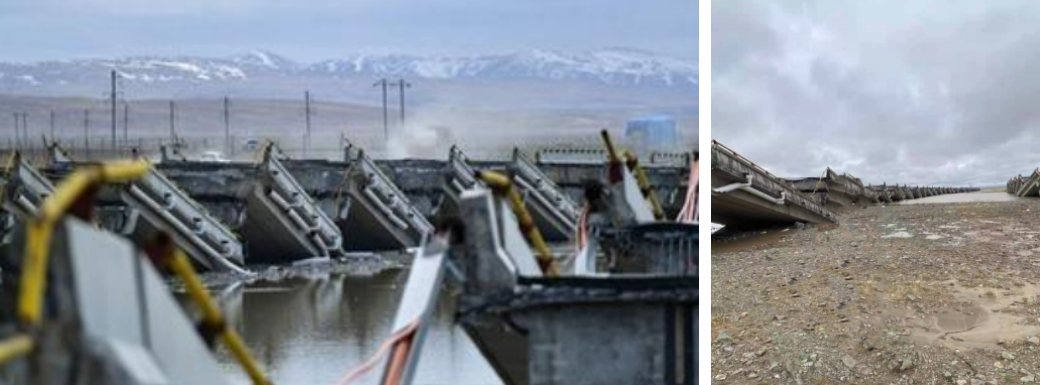
Figure 1: Pile Foundation Damage of Yematan Bridge [1]
2. Service Content
This project shall provide the project owner with services including calibration of pore pressure sensors and earth pressuresensors, as well as data analysis and processing.
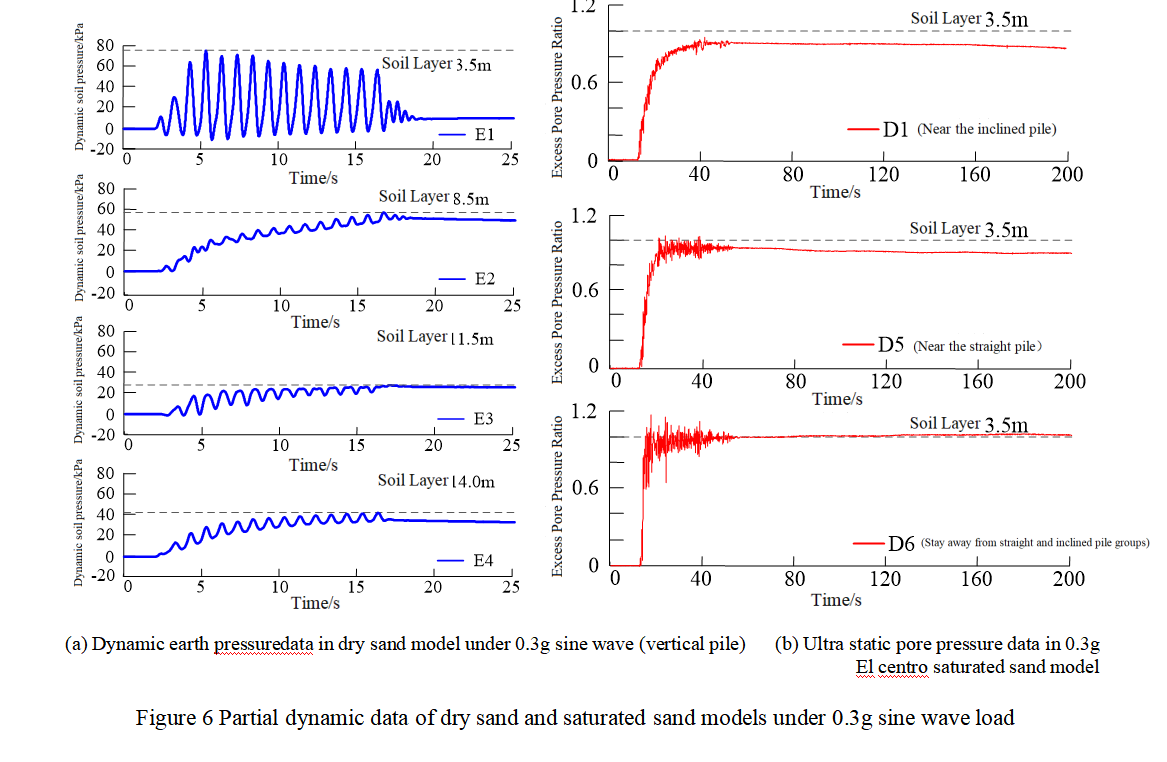
The pore pressure sensors provided for this project shall record in real time the "instantaneous" excess pore water pressure data under different seismic working conditions and the liquefaction dynamic response of the vertical-inclined group piles-saturated foundation; the earth pressuresensors provided shall record in real time the dynamic earth pressuredata of pile-soil interaction under seismic loads.
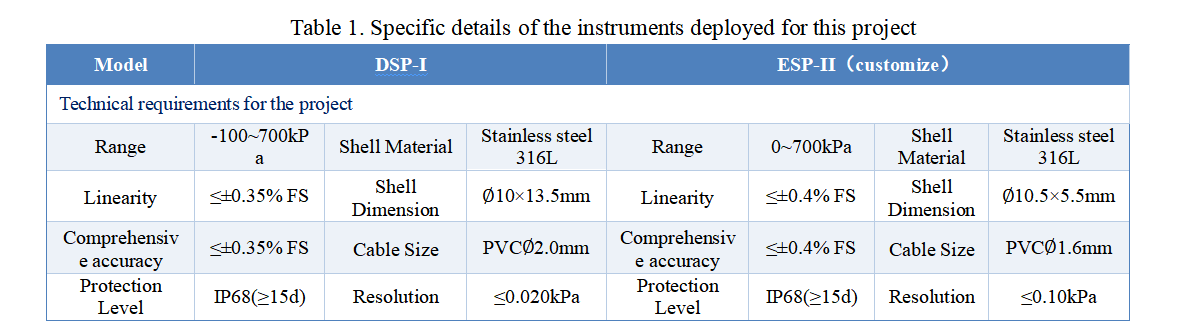
The pore pressure sensors used in this project shall meet the following requirements: miniaturization (diameter ≤ 10mm), high frequency response rate (response time ≤ 0.1ms), separable cleaning and saturation of the permeable stone, resistance to strong/weak electromagnetic interference, resistance to high centrifugal force (≥ 50g), resistance to impact load (≤ 80g), and resolution ≤ 0.020kPa (for recording changes in pore water pressure in soil). The earth pressuresensors shall meet the following requirements: miniaturization (diameter ≤ 12mm), high frequency response rate (response time ≤ 0.1ms), resistance to strong/weak electromagnetic interference, resistance to high centrifugal force (≥ 50g), resistance to impact load (≤ 80g), and resolution ≤ 0.10kPa (for recording changes in earth pressure of pile-soil interaction).
This project requires that the failure rate of pore pressure sensors shall be ≤ 5%, the failure rate of earth pressuresensors shall be ≤ 10%, and the duration of working conditions shall be ≥ 15 days.
The instrument models provided for this project are DSP-I pore pressure sensors and ESP-II earth pressure sensors, with main parameters shown in Table 1
3. Project Status and Representative Data
(1) Test Equipment
This centrifugal test adopts the DCIEM-40-300 large-scale centrifuge shaking table system from the Institute of Engineering Mechanics, China Earthquake Administration. The centrifuge has a radius of 5.5m, a maximum centrifugal acceleration of 100g, an effective static load of 3000kg, and a clear space of 1.5×1.2×1.6m. It is equipped with a horizontal unidirectional shaking table, which has the following parameters: maximum vibration acceleration of 30g, effective dynamic load of 1500kg, vibration frequency range of 10~300Hz, maximum displacement of ±15mm, maximum duration of 3s, and platform size of 1.5×1.0m.
(2) Test materials and saturation method
This experiment is divided into two groups: Group I for the dry sand model and Group II for the saturated sand model. The test chamber utilizes a self-designed layered shear model box (with internal dimensions of 1.20×0.50×0.65m (length × width × height), consisting of 12 laminated square frames and rubber layers). This model box can effectively simulate free-field conditions, significantly reducing the impact of boundary effects from the model box on the test results. The test sand is sourced from Tianjin Port sea sand, with an average particle size of d50=0.15mm. The dry sand model is prepared using the sand rain method in layers, achieving an average relative density of Dr=50%. The model preparation height is 345mm, corresponding to a prototype soil layer thickness of 17.25m. For the saturated sand model, a viscosity of 50cst-HPMC solution is selected as the saturated fluid, and the vacuum saturation method is employed, with a saturation time set at 48 hours.
(3) Test model and sensor deployment scheme
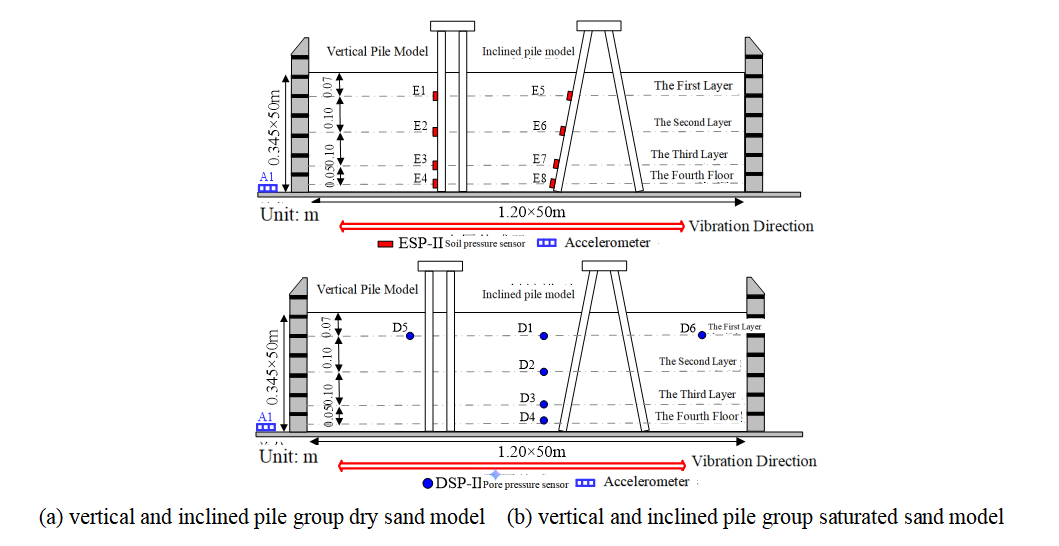
The layout scheme of DSP-I pore pressure sensor (in saturated sand model) and ESP-II earthpressure sensor (in dry sand model) is shown in Figure 2. The on-site technical guidance is shown in Figure 3. The physical diagram of a vertical and inclined pile model for a foundation project is shown in Figure 4.
(4) Load application scheme
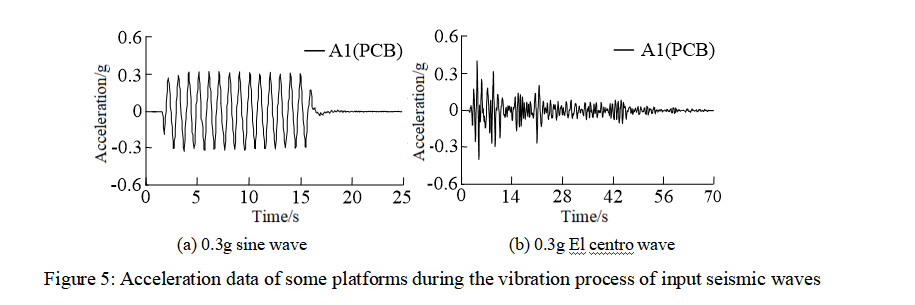
When the centrifugal acceleration reaches 50g, the shaking table will apply vibration loads, including sine waves with peak values of 0.05g, 0.1g, and 0.3g, as well as El-centro waves. The input partial seismic time-history curve is shown in Figure 5.
(5) Partial power test results
4. Service evaluation
This engineering project lasted for 16 days, and our technical personnel provided technical services throughout the project site, including guidance on sensor layout, troubleshooting, sensor wiring, and debugging of data acquisition instruments. More importantly, the data recorded by DSP-I pore pressure sensors and ESP-II earthpressure sensors provided important information for seismic research of pile foundations in foundation engineering.
User evaluation: The DSP-II pore pressure sensor and ESP-II dynamic earthpressure sensor have good frequency response rate and stability, long service life, and can be well applied to complex centrifugal environments (strong vibration/impact, high centrifugal force, strong electromagnetic interference). Especially, the DSP-II pore pressure sensor can accurately record the degree of disturbance of excess pore water pressure on the foundation during liquefaction of vertical and inclined piles (saturated sand model), and the ESP-II dynamic earthpressure sensor can accurately reflect the change law of pile-soil interaction (dry sand model). Both sensors have reached the leading technology level of similar products in China.
References:
[1] Strong vibration observation group of the engineering institute. Briefing on Strong Vibration Observation, Issue 8, 2021.

 Customer Service QQ